Budget Hearing: Tuesday, May 26th at 6:00pm.
Budget Vote: Tuesday, June 2nd, noon to 8:00pm.
Please Note: Community Members wishing to speak during the public expression portion of the budget hearing will need to follow rules of decorum, and will need to sign up to speak, as well as follow all policies relevant to the session. Our policies are available here.
FAQs for Dormann Library Tax Levy Proposal
1. What is the library asking for?
On December 1st, the Dormann Library Board of Trustees voted to propose an increase to the current tax levy to be voted on by the residents of the Bath Central School District. This proposal, if passed, would increase the library tax levy from $382,699 to $765,399.
2. Why does the library need an increase?
The Dormann Library and the residents of the Bath Central School District have been very fortunate for many years to be able to depend heavily on endowments left by charitable donors wishing to support the library. Unfortunately, due to rising operating costs and diminishing charitable gifts, the library has had to pull from its reserve fund to cover basic maintenance, utilities, wages, and insurances. These changes are not sustainable and will leave our endowment depleted if the library does not receive more public support from the community. Our library needs to increase its tax levy to continue to operate to the standards our community and our patrons have come to expect.
3. What will this increase mean for taxpayers?
A home or other property with an assessed value of $100,000 dollars is currently paying about $55.23 per year. If approved, this amount would increase to about $110.46 per year, or less than 56 cents more per $1000 of assessed valuations to support the library.
4. Will this percentage increase be the new normal?
No. As members of this same community, this increase is not something we expect—or want—to repeat. We intend this to be a one-time step to address current financial realities. Without it, the alternative would be significant service reductions. Please see our handout that discusses what will be cut if this budget does not pass. With a successful vote, we can stabilize operations and limit future increases to cost-of-living adjustments.
5. When and where will the vote take place?
The vote will take place from noon until 8:00pm on June 2nd, 2026 at the Dormann Library. We encourage all members of the school district to participate.
6. How will the library let taxpayers know about the upcoming proposal and vote?
The library has placed four ads in separate issues of the Shopper leading up to the vote to keep the community informed with important budget vote information including the current and proposed tax levy amount. The vote date and time, as well as the date and time for the Annual Budget Hearing, will also appear in our May Newsletter, on our printed calendars, our website and social media.
7. When will you present your budget changes in a public forum?
On May 26, 2026, patrons and community members are encouraged to come to our Annual Budget Hearing at 6:00pm. Anyone wishing to speak in support, raise concerns and ask questions will have time and a platform to do so. Those wishing to speak must sign up upon arrival and follow the rules of decorum, as well as the library policies. We encourage the community to come with questions.
8. How can I make my voice heard outside of the vote?
The Dormann Library Board of Directors holds board meetings several times a year, all of which are open to the public. The Board Meeting Schedule can be found on our website. Similar to our Annual Budget Hearing, these meetings offer patrons and members of the community an opportunity to ask questions, raise concerns for and speak to their experiences in and about the library.
9. How can I be more involved in the library?
There are tons of ways to be more involved in the library, including: attending board meetings and events, and even volunteering. If you are part of an organization wishing to partner with the library, we are always looking to find new and exciting ways to get resources out to our community. If you are interested in any of these opportunities, feel free to call (607) 776-4613 and ask for our assistant director, Jami. She would be thrilled to be your guide to library involvement and help you find the best route for you.
10. How will the proposition appear on the ballot?
Shall the annual sum of money to be raised by taxation from
the residents of the Bath Haverling Central School District for
the Dormann Library be raised from $382,699.00 to $765,399.00
annually.
11. Does this levy increase mean the school district is asking for more money?
No, this levy is unrelated to the school district’s funding. This money is for the library, which is an entirely separate entity, although we serve the same community.
Any additional questions can be directed to Jami Long at LongJ@STLS.org, or by calling the library at (607)776-4613
Clearing Up Common Misconceptions About the Library Budget
“Why can’t the library just cut waste?”
The library already operates with a lean budget.
Most library funding pays for staffing, materials, programming, utilities, and basic building operations, not extras.
There is no large pool of “waste” to eliminate.
Major cuts can only come from hours, staff, materials, and services.
Fixed costs such as utilities, wages, insurances, and building maintenance continue to rise. Non-profits are not immune to the affordability crisis. For example, our electric bill has tripled in the past two years, and our insurance bill doubled last year despite consistent efforts to reduce these cost wherever feasible.
“Why can’t the library use grants instead of tax dollars?”
The library earns an average of $150,000 in grants every year. However, grants:
- Are not guaranteed year to year
- Are restricted to specific projects
- Cannot be used for day-to-day operations, staffing, or utility bills.
- Are becoming harder to get with increasing competition due to funding cuts in other areas
A stable local budget is what allows the library to qualify for and manage grants in the first place.
“Can’t volunteers replace paid staff?”
Under the Fair Labor Standards Act (FLSA), a business cannot eliminate a paid position and then have volunteers perform the same core duties of that position. That is considered wage theft and a violation of federal law.
Volunteers are valuable, but they cannot replace trained library staff.
Many library services require:
- Professional training
- Confidentiality
- Consistent availability
- Legal and safety responsibility
Volunteers support services. They do not legally or practically replace staff.
“Why not just buy fewer books?”
Books and digital materials are a core service, not a luxury.
Cutting materials means:
- Longer waitlists
- Outdated information
- Fewer children’s and educational resources
A library without current materials is not saving money, it is failing its purpose. Books are our traditional, core service, and reading is on the rise (print and electronic) with seniors and younger generations in recent years.
Material costs as well as add-on costs for processing have risen significantly over the past few years. Despite efforts to curb this expense where possible, and some success any further cuts in this area would necessitate the elimination of core services.
“Everyone has internet at home now, right?”
No. With 22,299 Wi-Fi sessions recorded this year, reliable internet access remains one of the library’s most heavily used services. Public computers were also used 1906 times, reinforcing the ongoing need to invest in accessible technology and well-maintained equipment for our community.
Many residents still rely on the library for:
- Internet access
- Job applications
- School assignments
- Government forms
- Telehealth appointments
Reducing technology access widens the digital divide in our community.
“Why does the library need to be open evenings and weekends?”
The library regularly evaluates service hours to ensure they reflect community needs and responsible stewardship of public funds. While there are natural peak and slower periods throughout the day, usage data shows that the library is consistently utilized during all open hours. Reducing hours would limit access for working families, students, seniors, and residents who depend on the library at different times. Our goal is to maintain reliable access that meets the real and varied schedules of our community. Additionally, our library currently sits at 44 open hours per week which is just above the minimum required for a service area of our size. Unfortunately, a reduction to operating hours to this degree would have minimal impact on the tax cost for residents while further limiting accessibility for working people in our community.
Library Use is on the Rise
Yes. Library use is growing!
In 2025, the library held 595 programs, attended by 5,259 people. Nearly 30,000 items were borrowed by over 4000 patrons with active library cards.
Program attendance continues to increase, outreach efforts have expanded, and partnerships with county government agencies have strengthened our role as a community resource. From children’s programs to adult services, the library serves more residents in more ways than ever before.
Increased use brings increased responsibility:
- More wear and tear on facilities
- Higher demand for public computers, Wi-Fi, and technology –
- Greater staffing needs to maintain quality service and safety – the addition of a new tech support clerk
- Increased programming demand – attendance up to 5,259 (in 2025) from 4,745 (in 2024).
Growth requires maintenance and thoughtful investment—not cuts. Reducing funding would mean reducing access at a time when community reliance on the library continues to rise.
We have estimated the current return on investment for our library at $1.43 for every dollar the community contributes annually, based on conservative pricing averages and 2025 numbers. However, we can get this number up even higher as more people utilize our library.
What Happens If the Library Budget Does Not Pass?
A reduction to the library budget would not mean “trimming extras.” It would fundamentally change what the library is and who it serves. This is what a cut would look like in real terms.
Fewer Hours. Less Access.
- A reduction in open hours
- Loss of evening and weekend availability
- More frequent closures
Who is impacted: working families, students, seniors, and anyone who relies on the library.
Fewer Staff. Less Help.
- Reduced staffing levels
- Longer wait times for assistance
- Fewer trained professionals available
Result: less help with job searches, homework, technology, and research. The library becomes a room with books, not a service.
Fewer New Books & Materials.
- Notable reduced purchasing
- Longer waitlists for popular titles
- Outdated collections
Result: fewer children’s books, fewer large-print and accessible materials, fewer resources that reflect today’s community. Less materials available for programs and services.
Reduced Technology & Online Resources.
- Fewer public computers and devices
- Slower replacements and more breakdowns
- Loss of paid databases and digital services
Result: less access to the internet, job applications, telehealth, and online learning, especially for those without access at home.
Deferred Maintenance. Higher Costs Later.
- Repairs postponed
- Equipment failures increase
- Safety and comfort decline
Important reality: deferred maintenance doesn’t save money. It creates larger, more expensive problems later.
Programs Cut or Eliminated.
- Fewer children’s programs
- Reduced adult education and outreach
- Reduced community events and partnerships
Result: the library stops being a community hub and becomes a minimal service point.
The Bottom Line
Cutting our budget would not make the library “more efficient.” It would make it less available, less useful, and less equitable. This is not about luxuries. It is about maintaining the access, education, and shared community resources we have worked hard to create and grow, and preserve our endowment to benefit future generations of school district residents.
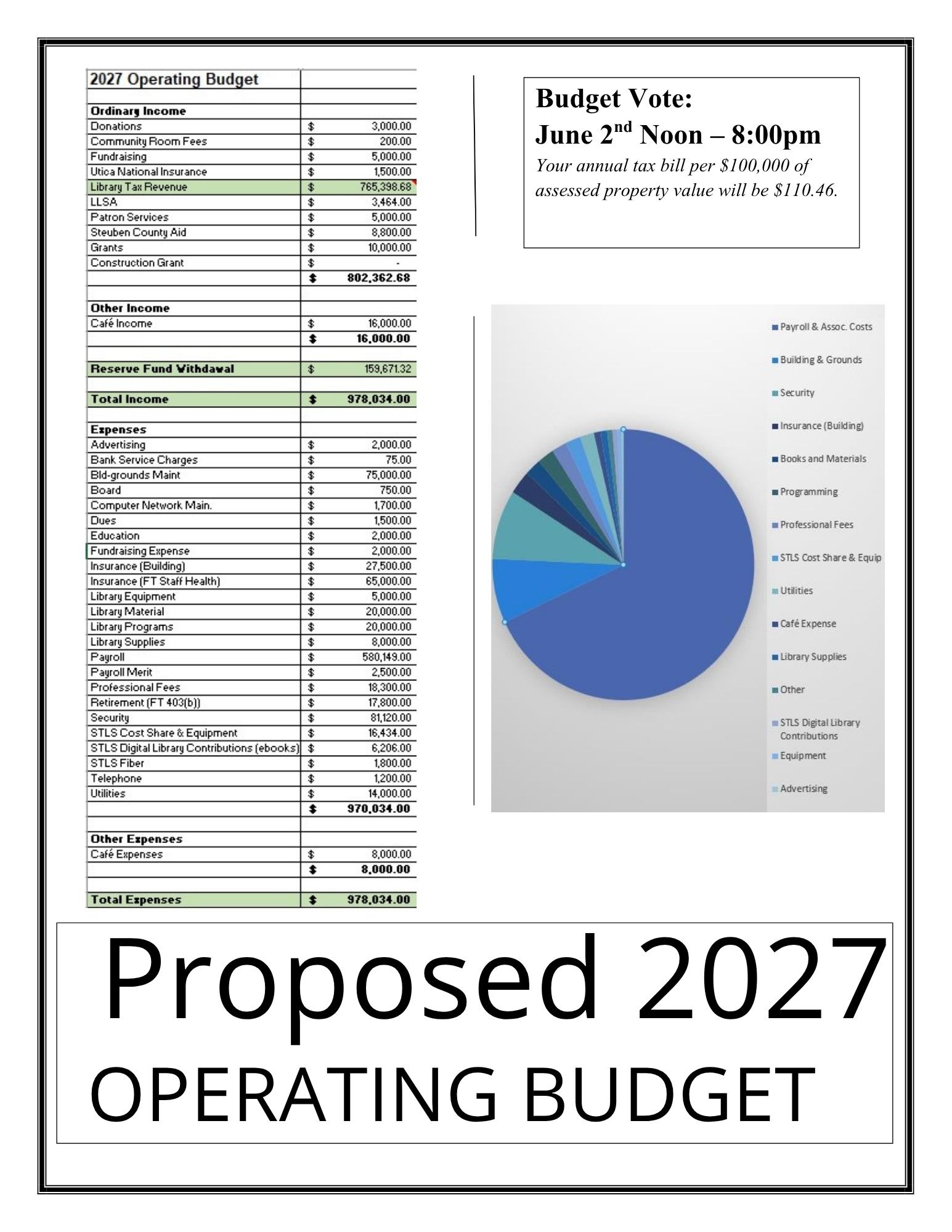
Click below to read our annual report. ⇓